INTERMEDIATE · 8 MODULES · 64 LESSONS

Multi-Agent Orchestration

Decide when it's worth splitting work across several agents and, when it is, coordinate them by hand in Python without relying on any framework.

For you if
You've already built an agent with tools and some tasks are too much for it alone.
By the end
You'll know how to apply five coordination patterns, measure what coordination costs, and pick the right pattern for each task.
You need
Python 3.14 with some dataclasses and concurrency. No API key, internet, or frameworks needed.
  1. 01Why Multi Agent And When Not To8 LESSONS
    1. Module 1: Why Multi-Agent (and When Not To)
    2. What a multi-agent system is
    3. The cost of coordination
    4. One agent with many tools vs. many agents
    5. The executed comparison
    6. When multi-agent actually helps
    7. A preview of the patterns
    8. Mini-project: decide single or multi
  2. 02The Supervisor Router Pattern8 LESSONS
    1. Module 2: The supervisor/router pattern
    2. What a supervisor does
    3. Deterministic routing with rules
    4. Routing by model decision
    5. Building pricing_agent
    6. The dispatcher executed end to end
    7. Choosing your router
    8. Mini-project: Reservo's supervisor
  3. 03Sequential Pipelines8 LESSONS
    1. Module 3: Sequential pipelines
    2. The anatomy of a stage
    3. Chaining data between stages
    4. Reservo's pipeline, executed end to end
    5. Measuring a pipeline's coordination cost
    6. When a stage fails
    7. Choosing pipeline or supervisor
    8. Mini-project: Reservo's pipeline
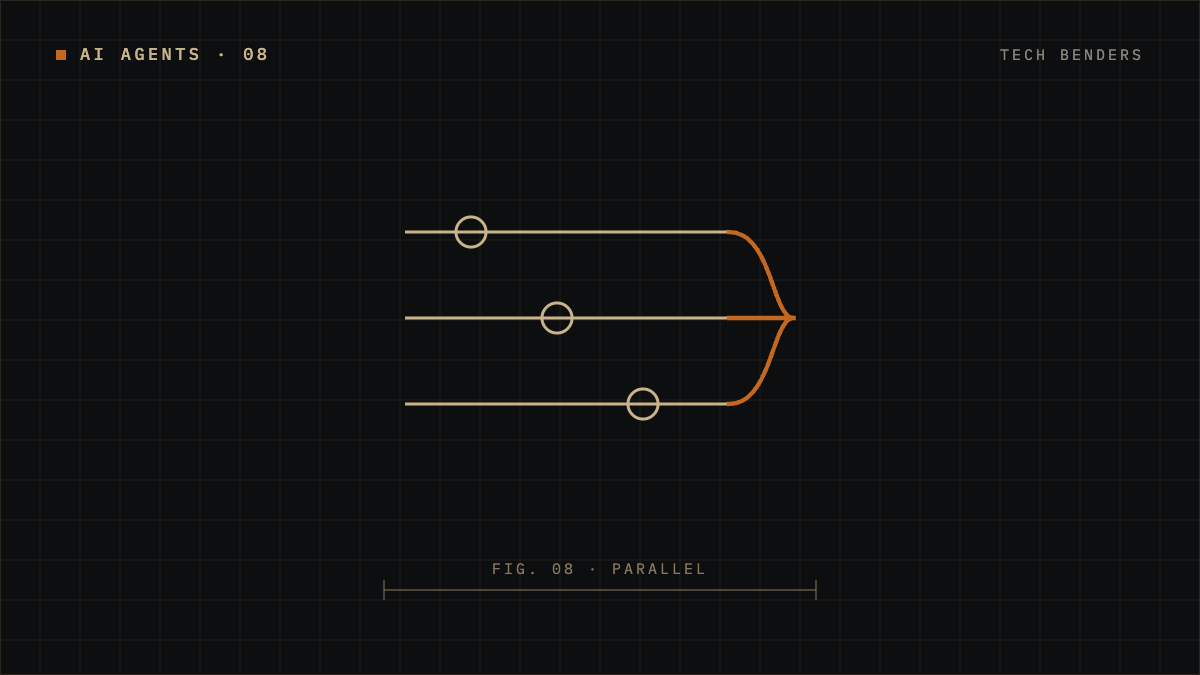
  4. 04Parallel Fan Out And Aggregation8 LESSONS
    1. Module 4: Parallel fan-out and aggregation
    2. Identifying independent sub-tasks
    3. The base case: fixed, enumerated order
    4. Aggregating results deterministically
    5. Fan-out inside a single agent: the pricing_agent variant
    6. Real concurrency with ThreadPoolExecutor
    7. Measuring the latency savings in rounds
    8. Mini-project: fan-out across Reservo
  5. 05Handoff And Delegation8 LESSONS
    1. Module 5: Handoff and Delegation
    2. Recognizing When a Handoff Is Needed
    3. The Handoff Package: What Goes In, What Stays Out
    4. The Handoff Tool and the Interrupted Loop
    5. Reservo's Handoff, Executed End to End
    6. Guarding Against Endless Handoff Chains
    7. Measuring the Cost of a Direct Handoff
    8. Mini-Project: Handoffs in Reservo
  6. 06Shared State And The Blackboard Pattern8 LESSONS
    1. Module 6: Shared State and the Blackboard Pattern
    2. Anatomy of the Blackboard
    3. Writing to the Blackboard
    4. Reading from the Blackboard
    5. The Write Log
    6. The Trade-off Measured: Visibility vs. Isolation
    7. The Full Run: The Supervisor and Three Specialists Share a Blackboard
    8. Mini-Project: Reservo's Blackboard
  7. 07Orchestrating The Full Reservo System8 LESSONS
    1. Module 7 Introduction: Combining the Patterns Over a Real Request
    2. Anatomy of a Compound Request
    3. The Supervisor Decides, the Pipeline Validates Before Booking
    4. The Independent Questions Run in Fan-out While the Pipeline Resolves
    5. An Agent Hands Off Mid-way Through a Fan-out Branch
    6. A Blackboard, Shared by All Three Patterns at Once
    7. The Full Composed Run, Executed End to End
    8. Mini-Project: Three Compound Requests for Reservo
  8. 08Project The Reservo Multi Agent System8 LESSONS
    1. Module 8 Introduction: The Capstone, Reservo's Complete System
    2. Assembling the Supervisor and the Specialists
    3. Wiring in the Pipeline
    4. Wiring in Fan-out
    5. Wiring in a Handoff
    6. One Blackboard for the Whole System
    7. Measuring the Coordination Cost of the Complete System
    8. Project: The Reservo Multi-Agent System
Reviews

What students say

These reviews are from enrolled students who completed at least 50% of the course. We moderate reviews only on content grounds (spam, offensive language, personal data), never for being critical or negative.

No approved reviews yet.

Be the first to share your experience!

SEC. 06 · THE STUDIO

Why this studio exists

For decades, building software belonged to technical profiles with years of training, and getting a digital product into the real world took companies months or years. No-code and AI have narrowed that gap, but the knowledge is still held by a few.

Tech Benders exists to open that knowledge up, so business teams and non-technical teams can put their ideas into production with the right technical decisions behind them. AI does what you ask of it. Without a technical base, what it builds may not scale with your company’s ecosystem, and its costs can run away over time.

The team knows the pains of large organizations and the speed at which they have to move. It brings solution architecture, data engineering, product built end to end from back end to front end, and daily work with AI. Software that solves what you need in days, not months, with the cost of AI kept in check.

Founders

The studioRead about Tech Benders →

Write to ushi@techbenders.io

Made with Wislab